The price at the pump has hit £1.20, of which about 45p goes to the retailer and the oil company and the rest, approx 75p per litre goes to the Government in VAT and fuel duty.
The Government has the power to bring down the price at the pump but it will not as this is views as a "green tax" and they, plus the opposition parties will not do anything to anger the Green Lobby, even if it would make a very real and very helpful hand to business and families alike.
My solution is neither original nor will it bring down the prices right away. We should as voters demand it be law that all receipts issued by cashiers should itemise what you have just handed money over for, be it VAT or Fuel Duty; whether you are filling up your car, or buying a meal in a restaurant or buying a few bottles of cider at the supermarket.
The result, I would hypothesise would be that people would start to see how much they are handing over in indirect taxations, and that would in turn bring into the debate in clearer terms such duties as is levied on fuel, on cigarettes, the tax we pay when we eat out and when we buy a round of drinks. Perhaps if people could see that for every £50 of petrol that goes in the car £34 was heading to Westminster there would be more debate on excessive, and largely hidden taxation.
Showing posts with label Taxes. Show all posts
Showing posts with label Taxes. Show all posts
Thursday, April 08, 2010


Tuesday, March 16, 2010
Fuel Duty
Here is a graph that I hope gets some wide attention, it tracks the price of petrol at the pump over the last few years. I saw it on Political Betting, who in turn took it from WhatGas.Com
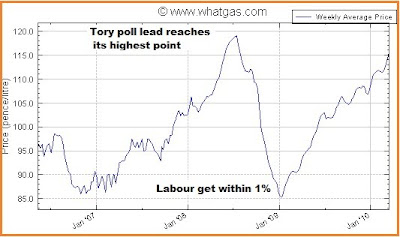
Petrol prices are way too high because it is relentlessly taxed. The pips are squeaking because we are being pressed too hard. I understand that not everybody agrees with me on points of the environment, but nobody buys petrol who doesn’t need it, allowing the price to fall by an easing of fuel duty is not going to encourage people to go out and buy additional petrol, it is just going to make life a little easier for people who are struggling.
This graph is a little out of date, but makes the point quite nicely.

The Tories have traditionally done well when people are feeling the squeeze because they are viewed as the low tax party and have traditionally been on the side of families when it comes to tax and welfare. I suspect this will change in the next few years as the Conservatives seem to have accepted the notion of moving towards so called “green taxes” which will probably mean that fuel duties will not come down under them.
This is one of the areas I think the Conservatives could explain better. I am looking for a low tax party and despite the recession I think there are many in the Conservative Party that will push for tax cuts to bolster demand and consumer spending in a year or so once their feet are under their desks and the majority of cuts have been initiated. But, if the Tories are going green and we cannot expect relief on tax duties or tax relief on such things as flights, where will the Conservatives make things easier for their core voters? I don’t know and I want to know and it is not something that would require a concrete pledge; a nudge would suffice.

Petrol prices are way too high because it is relentlessly taxed. The pips are squeaking because we are being pressed too hard. I understand that not everybody agrees with me on points of the environment, but nobody buys petrol who doesn’t need it, allowing the price to fall by an easing of fuel duty is not going to encourage people to go out and buy additional petrol, it is just going to make life a little easier for people who are struggling.
This graph is a little out of date, but makes the point quite nicely.

The Tories have traditionally done well when people are feeling the squeeze because they are viewed as the low tax party and have traditionally been on the side of families when it comes to tax and welfare. I suspect this will change in the next few years as the Conservatives seem to have accepted the notion of moving towards so called “green taxes” which will probably mean that fuel duties will not come down under them.
This is one of the areas I think the Conservatives could explain better. I am looking for a low tax party and despite the recession I think there are many in the Conservative Party that will push for tax cuts to bolster demand and consumer spending in a year or so once their feet are under their desks and the majority of cuts have been initiated. But, if the Tories are going green and we cannot expect relief on tax duties or tax relief on such things as flights, where will the Conservatives make things easier for their core voters? I don’t know and I want to know and it is not something that would require a concrete pledge; a nudge would suffice.
Monday, March 01, 2010
Just A Bag
The cat is out of the bag, well, there never really was a cat was there was just an empty sack and the biggest non-secret in politics that Lord Ashcroft is a non-dom has made the news today and surprised nobody. His statement today clarifies his tax position, and presumably he then took questions about bears defecating in the woods and the true political allegiance of the Pope.
Lord Ashcroft mentions Lord Paul and Sir Ronald Cohen both of whom are Labour donors and Non-Dom's. Iain Dale was very quick to make available a more extensive list.
It does not change the fact that the two parties are screaming at each other for doing exactly the same thing as each other for what basically boils down to nothing at all. It really is time for Gordon Brown or David Cameron to get out in front of the pettiness and to start putting the country first. My suspicions has long been that in a Post-Lisbon world, the Governing party has become so restricted in what it may and may not do, that elections have become about who has the blacker cat.
Away from Westminster, we just don't care.
“I am making this statement in advance of the release by the Cabinet Office of limited information about the award of my peerage and of the undertakings I gave at the time. While I value my privacy, I do not want my affairs to distract from the general election campaign.
“I have therefore decided to release a copy of the letter which I wrote to William Hague, and to expand on what actually happened. As the letter shows, the undertakings I gave were confirmed in a memorandum to William Hague dated 23rd March 2000. These were to “take up permanent residence in the UK again” by the end of that year. The other commitment in the memorandum was to resign as Belize’s permanent representative to the UN, which I did a week later.
“In subsequent dialogue with the Government, it was officially confirmed that the interpretation in the first undertaking of the words “permanent residence” was to be that of “a long term resident” of the UK. I agreed to this and finally took up my seat in the House of Lords in October 2000. Throughout the last ten years, I have been declaring all my UK income to HM Revenue.
“My precise tax status therefore is that of a “non-dom”. Two of Labour’s biggest donors – Lord Paul (recently made a privy councillor by the Prime Minister) and Sir Ronald Cohen, both long-term residents of the UK, are also “non-doms”.
As for the future, while the non-dom status will continue for many people in business or public life, David Cameron has said that anyone sitting in the legislature – Lords or Commons – must be treated as resident and domiciled in the UK for tax purposes. I agree with this change and expect to be sitting in the House of Lords for many years to come.”
Lord Ashcroft mentions Lord Paul and Sir Ronald Cohen both of whom are Labour donors and Non-Dom's. Iain Dale was very quick to make available a more extensive list.
Lord Paul – £69,250 in donations to Labour, including £45,000 to Gordon Brown’s leadership campaign. A close friend of Gordon Brown and appointed to the Privy Council last summer, he has admitted to being ‘non-dom’.
• Lakshmi Mittal - £4.125 million in donations to Labour.So, basically both parties are upto the same thing, whilst painting a picture that the other is doing something wrong or immoral. There would appear to be no breaches in the rules or the laws on donations. It does however seem that whilst Labour have been bleating on about Lord Ashcroft they have been unwilling to put forth any recommendations for rule changes; probably because they clearly have more to lose than the Conservatives from any changes in the rules.
• Sir Ronald Cohen - £2.55 million in donations to Labour. Cohen was appointed chair of the Social Investment Taskforce, which was announced by the then Chancellor, Gordon Brown
• Sir Christopher Ondaatje - £1.7 million in donations to Labour.
• Sir Gulam Noon - £532,826 in donations to Labour.
• William Bollinger - £510,725 in donations to Labour.
• Mahmoud Khayami - £985,000 in donations to Labour including £5,000 to Hazel Blears’ deputy leadership campaign. He has helped bankroll two flagship schools, one of which Gordon Brown opened, and was personally thanked for a donation by Tony Blair.
• Dr David Potter - £90,000 in a donation to Labour. He has previously delivered a lecture at Downing Street.
It does not change the fact that the two parties are screaming at each other for doing exactly the same thing as each other for what basically boils down to nothing at all. It really is time for Gordon Brown or David Cameron to get out in front of the pettiness and to start putting the country first. My suspicions has long been that in a Post-Lisbon world, the Governing party has become so restricted in what it may and may not do, that elections have become about who has the blacker cat.
Away from Westminster, we just don't care.
Tuesday, November 17, 2009
Tax Doesn't Have To Be Taxing
.... Apparently it does actually.

I spent 3 hours in a meeting today, which I initially thought was to prepare us for the UK rate change on 1st January but was actually to tell us that tax rules throughout the EU are changing, especially in relation to services. And with about 6 weeks to go, some of the national legislation has not yet been published. This is an issue for us when transacting for example out of Germany. Most of this stems from an EU directive passed in February 2008, however national Governments have still not put the legislation in place formally leaving all businesses precious little time now to be prepared.
The point is, I work for a big IT company, and we pay a well known Financial Services firm for accountancy advise and we pay a lot of money for a well known IT software to transact our business on. None of it can be compliant today with the (known) changes. We will work hard and undoubtedly have to pay to get compliant before the deadline. But we have just 6 weeks to meet compliance with as yet unwritten tax laws and with as yet unannounced VAT rates and changing EU VAT regulations.
If you are a part of, or know someone who is a part of a business that transacts cross-border sales, especially if they transact any type of services, please tell them to call their tax accountant right away. My company will find this exceptionally challenging - if you are a small business you are about to get completely walloped.
It is not just rules and rates that are changing; there are filing timeline changes in some EU countries (with subsequent fines for non-compliance).
Good luck!

The point is, I work for a big IT company, and we pay a well known Financial Services firm for accountancy advise and we pay a lot of money for a well known IT software to transact our business on. None of it can be compliant today with the (known) changes. We will work hard and undoubtedly have to pay to get compliant before the deadline. But we have just 6 weeks to meet compliance with as yet unwritten tax laws and with as yet unannounced VAT rates and changing EU VAT regulations.
If you are a part of, or know someone who is a part of a business that transacts cross-border sales, especially if they transact any type of services, please tell them to call their tax accountant right away. My company will find this exceptionally challenging - if you are a small business you are about to get completely walloped.
It is not just rules and rates that are changing; there are filing timeline changes in some EU countries (with subsequent fines for non-compliance).
Good luck!
Monday, August 31, 2009
The Price At The Pump
Petrol at the pump has hit 105.9p per litre at my local filling station, yet despite the high price and the fact that oil prices are expected to rise for the rest of this year the Government is adding a further 2p per litre in duty from midnight tonight (2.3p including VAT).
At a time when families are feeling the pinch, and considering the already high levels of duty already collected on fuel, why is the Government pressing ahead with this raise? With the increases in oil price in the last two years prices are up about 40p in a litre already, and that includes additional VAT being collected. If the Conservatives have opposed this move they have not been vocal enough about it, as I haven’t heard any protest from anyone.
If the government really wants to help poor people it should reverse immediately the increase in fuel duty and let everyone of us know what they are doing to help reduce the price of petrol to UK consumers; excluding of course their recently uncovered policy of trading convicted terrorists for oil contracts.
Update 01-Sep-09: Tarquin helpfully provides the below graph which he rightly mentions makes the point much better than words can:

At a time when families are feeling the pinch, and considering the already high levels of duty already collected on fuel, why is the Government pressing ahead with this raise? With the increases in oil price in the last two years prices are up about 40p in a litre already, and that includes additional VAT being collected. If the Conservatives have opposed this move they have not been vocal enough about it, as I haven’t heard any protest from anyone.
If the government really wants to help poor people it should reverse immediately the increase in fuel duty and let everyone of us know what they are doing to help reduce the price of petrol to UK consumers; excluding of course their recently uncovered policy of trading convicted terrorists for oil contracts.
Update 01-Sep-09: Tarquin helpfully provides the below graph which he rightly mentions makes the point much better than words can:

Monday, April 27, 2009
50p Tax Rate Reaction #1
"To pick on a small group of people is not the basis of a tax policy," the former Transport Secretary said. Why was it timed to come in before the election next year, "when this is clearly political positioning rather than a principled or strategic approach to taxation."
"It was an elephant trap so large that even the most myopic old tusker could see it," he said, and should be opposed because "it is damaging to the Labour party in Government. It breaks a key manifesto pledge which the party will regret for many years to come." If it was so important, it should have been introduced after the election to avoid breaching a manifesto pledge. Instead it was done for "cynical political reasons". He finished: "Is it a short term or a permanent measure? The Chancellor had implied it was short term. Others in the Cabinet disagreed."
Quotes attributed to former Cabinet minister Stephen Byers, and was lifted from Brogans Blog.
"It was an elephant trap so large that even the most myopic old tusker could see it," he said, and should be opposed because "it is damaging to the Labour party in Government. It breaks a key manifesto pledge which the party will regret for many years to come." If it was so important, it should have been introduced after the election to avoid breaching a manifesto pledge. Instead it was done for "cynical political reasons". He finished: "Is it a short term or a permanent measure? The Chancellor had implied it was short term. Others in the Cabinet disagreed."
Quotes attributed to former Cabinet minister Stephen Byers, and was lifted from Brogans Blog.
Subscribe to:
Posts (Atom)