Showing posts with label Parliament. Show all posts
Showing posts with label Parliament. Show all posts
Wednesday, November 18, 2009
The Queens Speech
I'll save you 6 minutes, The Queen says... "My Prime Minister has a cunning plan" in her best Baldrick voice then reeled off a load of predictable nonsense from a Labour written handbook. The End.


Tuesday, November 17, 2009
Tax Doesn't Have To Be Taxing
.... Apparently it does actually.

I spent 3 hours in a meeting today, which I initially thought was to prepare us for the UK rate change on 1st January but was actually to tell us that tax rules throughout the EU are changing, especially in relation to services. And with about 6 weeks to go, some of the national legislation has not yet been published. This is an issue for us when transacting for example out of Germany. Most of this stems from an EU directive passed in February 2008, however national Governments have still not put the legislation in place formally leaving all businesses precious little time now to be prepared.
The point is, I work for a big IT company, and we pay a well known Financial Services firm for accountancy advise and we pay a lot of money for a well known IT software to transact our business on. None of it can be compliant today with the (known) changes. We will work hard and undoubtedly have to pay to get compliant before the deadline. But we have just 6 weeks to meet compliance with as yet unwritten tax laws and with as yet unannounced VAT rates and changing EU VAT regulations.
If you are a part of, or know someone who is a part of a business that transacts cross-border sales, especially if they transact any type of services, please tell them to call their tax accountant right away. My company will find this exceptionally challenging - if you are a small business you are about to get completely walloped.
It is not just rules and rates that are changing; there are filing timeline changes in some EU countries (with subsequent fines for non-compliance).
Good luck!

The point is, I work for a big IT company, and we pay a well known Financial Services firm for accountancy advise and we pay a lot of money for a well known IT software to transact our business on. None of it can be compliant today with the (known) changes. We will work hard and undoubtedly have to pay to get compliant before the deadline. But we have just 6 weeks to meet compliance with as yet unwritten tax laws and with as yet unannounced VAT rates and changing EU VAT regulations.
If you are a part of, or know someone who is a part of a business that transacts cross-border sales, especially if they transact any type of services, please tell them to call their tax accountant right away. My company will find this exceptionally challenging - if you are a small business you are about to get completely walloped.
It is not just rules and rates that are changing; there are filing timeline changes in some EU countries (with subsequent fines for non-compliance).
Good luck!
Sunday, November 08, 2009
Pictures From Westminster
Terrible, really not so good... None the less here they are.


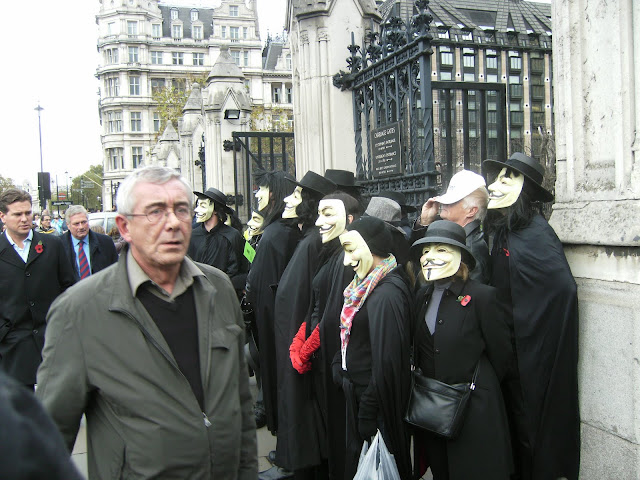


On the way out from the gallery, Old Holborn and some others were sidelined by security, though I did not get to hear why. I was told third-hand that they wanted to know why we were all there, and identified him as the group leader. Given the reaction from other staff, this may well have been from genuine curiosity and support, though my guess is that OH would have not given them any more info than he wanted to.


A good day was had by all. To the surprise of some there, we were as a group allowed up into the public gallery, though not before it was checked with Parliamentary security what the rules were for entering with masks on... eventually we were waived through into the airport style scanners, were photographed and then queued up where you have to provide your name and address on an official looking form whereby you promise not to disrupt proceedings from the gallery. All masks and costumes had to be removed. Truth is, after only a few minutes of listening to a climate change debate was needed for Old Holborn and the rest of us to fancy heading back to the pub; so we left.
My attendance on the day was in part because I dislike our government and what they are doing, and I am angry with what is going on in Parliament. I do not feel represented, and I like to get up to Parliament a few times a year to join in with various protests and marches. Old Holborn would probably point out that this was not a protest, and that would be true, which was my second reasoning. I wanted to see if a group of individuals who are openly critical of Government could still access Parliament and get in slapping range of our elected and unelected politicians. With laws being passed that will not allow for unapproved protesting around Parliament, and that prevent people from taking photographs in the street all in the name of protecting us from terrorism, but really enabling MP's and the state to be more and more removed from people; my fear was that a group of people with dissenting opinions may be stonewalled under anti-terrorism laws. In the grandest traditions of British protest and eccentricity, the land where a person will roll a penny for miles to raise money for charity, walk the marathon in a submariners suit and where magicians will live in a perspex box over the river for a few months, what level of fear, if any would a group of people in plastic masks attempting to watch our government function first hand generate?
From the pub where I met the group who had already been to Downing Street it would seem we were under what I assume was police surveillance. We walked from the Westminster Arms to St Stephens Gate at the front of Parliament. I found out later that on the way there some of the costumed attendees had met with remarks in the street from people who assumed, well, I am not sure what they assumed, but they felt free enough to let off some disparaging remarks. At Parliament the main players were denied access initially in their costumes but eventually, when security was satisfied (and after Tory Bear had conducted an Interview for Guy News) we were ushered in and very subtly broken into smaller groups. Firstly by allowing only a few through the initial security barriers, then by making us queue before heading up to the gallery. During this time additional groups, including school children were allowed through so as to separate us out. They needn't have worried, everyone I spoke with was polite and in no way hostile; and quite possibly there out out the same kind of curiosity as I. It is also worth mentioning that the Police, and uniformed "Police Staff" were again as with my previous visits exceptionally polite, and as with before they seem to enjoy seeing people turn up who will give politicians something to think about. From previous visits and this one it is clear that the resentment the public feels leads right up to Parliament and is felt by those who protect the fantastic building and those who work there.
On the way out from the gallery, Old Holborn and some others were sidelined by security, though I did not get to hear why. I was told third-hand that they wanted to know why we were all there, and identified him as the group leader. Given the reaction from other staff, this may well have been from genuine curiosity and support, though my guess is that OH would have not given them any more info than he wanted to.
And that was that, which lead then to my third and in truth the biggest motivator for going and that was a chance to go have a drink with some fellow bloggers which is always good fun. Before heading home, The Boiling Frog and I nipped back to the St Stephens Tavern for a quick pint of Badger Beer which has been living in the memory since the May jolly organised by Steve Green.
So it was a good day and a good experience. Having had a read around everyone seems to have attended and taken away something different from the day. They do this kind of thing more justice than I do in their writings, so here are a few recommended links to get some different perspectives (and some much better pictures).
Old Holborn - Hogwarts
Anonymong - Thoughts on a second walk
Snowolf - The one that had a good time...
Billy Blofeld - Old Holborns walk
Dick Puddlecote - Stroll On
Guthrum - In the words of Max Boyce - I was there
And this from Dungeekin, who did not make it but it sounds like he will do next year.
Tuesday, October 13, 2009
Interesting Story, Or Not...
I have been reading, or not reading what Carter Ruck is, or is not up to in relation to the Guardian, Parliament and potential questions that may, or may not be asked. Seems while I was asleep last night this all brewed up and the blogosphere found a few juicy questions that may, or may not have been cause for censor. Seems that looking through the order book has revealed that there is still much to pay attention to. A number of different solid theories have been advanced and there may, or may not, or may be supporting documents on Wikileaks, perhaps.
I had a look myself this morning, and I am a little surprised, or not, that nobody thought that this might be the offending enquiry. Though not seriously, perhaps, maybe.
![]()
Perhaps only because this would be more exciting, and movie-esque, or not. I guess we all hit a question we thought it might be... Still I would like to know the answers to these.
I had a look myself this morning, and I am a little surprised, or not, that nobody thought that this might be the offending enquiry. Though not seriously, perhaps, maybe.

Perhaps only because this would be more exciting, and movie-esque, or not. I guess we all hit a question we thought it might be... Still I would like to know the answers to these.
Tuesday, June 23, 2009
The Wet Parliament
For many years now, notable Parliaments have earned nicknames, usually telling or mocking by nature but which summarises their term and how they are remembered by. I will list a few examples below, but I was just thinking about what this Parliament would be remembered as.
A few months back, I felt sure that History would remember the Lisbon Treaty stitch-up and deride this Parliaments’ role in it, however, it now seems more likely (to me) that the current MPs expenses revelations will be the abiding memory.
So my suggestion would be the wet Parliament, because of the spit and bile so generally reserved and aimed by the public towards those who sit within and have profited personally so much from this Parliament. I would not believe anyone who told me that there had been a Parliament which came before which ignored its manifesto commitments so egregiously or which contained a group so self-interested.
Anyway, I am sure you can come up with better so let me know in the comments. But for some ideas, here are a few example of previous Parliaments.
The Long Parliament (actually had in part 2 nicknames ) – Was formed by Charles I in 1640 and was formed following the Bishops Wars. It earned its name from the fact that through a unique Act of Parliament it could only be dissolved with the agreement of its members. It sat between 1640 and 1649, when it was purged by the New Model Army of Parliamentarian. Those who sat past this purge sat in what became known as the Rump Parliament.
The Rump Parliament – This Parliament, now free of those who were opposed to the notion of trying the King for Treason but were under effective control of the Army during and after the Civil War until restoration in 1660. It was known as the Rump Parliament as an homage to the hind end of an animal, refereeing to it as a remnant.
The term has been used since on any Parliament which is left over from a Legitimate Parliament.
The Mad Parliament (1258) – was formed during the reign of Henry III of England in Oxford which founded through disaffection with the King then laid out the Provisions of Oxford founding a 15 member Privy council to supervise ministerial appointments, local administration and custody of Royal Castles. The Mad Parliament met three times a year to monitor the performance of the Privy Council.
The Parliament of Devils (1459) – this Parliament was summoned in October 1459 in Coventry and lasted until December 1459 and its main business was to bring charges of Treason against Yorkshire Noblemen during the War of the Roses.
The Parliament of Bats (1426) – Held in 1426 in Leicester, and is so named for the ban on carrying swords implemented by the Duke of Gloucester. As such, members brought clubs and bats.
A few months back, I felt sure that History would remember the Lisbon Treaty stitch-up and deride this Parliaments’ role in it, however, it now seems more likely (to me) that the current MPs expenses revelations will be the abiding memory.
So my suggestion would be the wet Parliament, because of the spit and bile so generally reserved and aimed by the public towards those who sit within and have profited personally so much from this Parliament. I would not believe anyone who told me that there had been a Parliament which came before which ignored its manifesto commitments so egregiously or which contained a group so self-interested.
Anyway, I am sure you can come up with better so let me know in the comments. But for some ideas, here are a few example of previous Parliaments.
The Long Parliament (actually had in part 2 nicknames ) – Was formed by Charles I in 1640 and was formed following the Bishops Wars. It earned its name from the fact that through a unique Act of Parliament it could only be dissolved with the agreement of its members. It sat between 1640 and 1649, when it was purged by the New Model Army of Parliamentarian. Those who sat past this purge sat in what became known as the Rump Parliament.
The Rump Parliament – This Parliament, now free of those who were opposed to the notion of trying the King for Treason but were under effective control of the Army during and after the Civil War until restoration in 1660. It was known as the Rump Parliament as an homage to the hind end of an animal, refereeing to it as a remnant.
The term has been used since on any Parliament which is left over from a Legitimate Parliament.
The Mad Parliament (1258) – was formed during the reign of Henry III of England in Oxford which founded through disaffection with the King then laid out the Provisions of Oxford founding a 15 member Privy council to supervise ministerial appointments, local administration and custody of Royal Castles. The Mad Parliament met three times a year to monitor the performance of the Privy Council.
The Parliament of Devils (1459) – this Parliament was summoned in October 1459 in Coventry and lasted until December 1459 and its main business was to bring charges of Treason against Yorkshire Noblemen during the War of the Roses.
The Parliament of Bats (1426) – Held in 1426 in Leicester, and is so named for the ban on carrying swords implemented by the Duke of Gloucester. As such, members brought clubs and bats.
Monday, June 22, 2009
MPs Choice - Who Cleans Up Parliament?
John Bercow's voting record towards a transparent Parliament:

Not a great day for our Democracy
 George Youngs voting record towards a transparent Parliament:

Not a great day for our Democracy
Friday, June 19, 2009
Did Gordon Brown Lie To Parliament?
Mark Reckons and Constantly Furious have appealed for some wider coverage to their posts (which I am happy to do)... I link to their original posts above. I would also encourage other bloggers to spread the word.
Three Line Whip (Alex Singleton) had a piece today which reveals that a Downing Street staff member has said that Gordon Brown was briefed by Damian McBride just before going onto the Andrew Marr show on 31st May 2009.
During PMQ's this week the PM was asked:
Mr. Lee Scott (Ilford, North) (Con): Will the Prime Minister tell the House whether the Government have received any informal briefings from Damian McBride?
The Prime Minister: I have not.
Thus, we can safely surmise that the Prime Ministers pants are ablaze.
Three Line Whip (Alex Singleton) had a piece today which reveals that a Downing Street staff member has said that Gordon Brown was briefed by Damian McBride just before going onto the Andrew Marr show on 31st May 2009.
During PMQ's this week the PM was asked:
Mr. Lee Scott (Ilford, North) (Con): Will the Prime Minister tell the House whether the Government have received any informal briefings from Damian McBride?
The Prime Minister: I have not.
Thus, we can safely surmise that the Prime Ministers pants are ablaze.
Saturday, June 13, 2009
Catching Up
It has been a busy week, my manager has been over from the US and one of my in-laws has been unwell, so I have had very little time for the news, let alone to post anything on the blog.
I haven't been reading the papers, I haven't seen much news, I missed PMQ's, Question Time, This Week and my regular Thursday live-blog on B-BBC.
I did hear about Ronaldo's move to Real, but that is for another blog.
However, I was looking forward to the prospect of what might occur from the dissolution debate on Wednesday, so I made the occasional two second visit to Sky News and BBC on Wednesday, but these revealed nothing.
I half expected (well, hoped) to hear crowds spontaneously break into applause as a dissolution was announced, but it got to the end of the day and there was nothing in the news about what had happened.
I am struggling to find a comprehensive write up, but I understand that there was a poor turn-out, and by virtue of Parliament still sitting I guess the Government won the vote.
Very disappointing.
Anyway, I did stumble upon this clip from the debate, which is of William Hague in fine form.
I will easing myself back into blogging over the next few days.
I haven't been reading the papers, I haven't seen much news, I missed PMQ's, Question Time, This Week and my regular Thursday live-blog on B-BBC.
I did hear about Ronaldo's move to Real, but that is for another blog.
However, I was looking forward to the prospect of what might occur from the dissolution debate on Wednesday, so I made the occasional two second visit to Sky News and BBC on Wednesday, but these revealed nothing.
I half expected (well, hoped) to hear crowds spontaneously break into applause as a dissolution was announced, but it got to the end of the day and there was nothing in the news about what had happened.
I am struggling to find a comprehensive write up, but I understand that there was a poor turn-out, and by virtue of Parliament still sitting I guess the Government won the vote.
Very disappointing.
Anyway, I did stumble upon this clip from the debate, which is of William Hague in fine form.
I will easing myself back into blogging over the next few days.
Sunday, June 07, 2009
Should We Look To Have An Elected Upper House? - Part 1
Part 1, The 1911 Parliament Act
With a lot of talk of constitutional reform pinging around the world of politics and the blogosphere I thought I would take some time and make the case for an elected second chamber. This needs to begin with a look at the why the Lords has limited its role in the twentieth century, chiefly the 1911 Parliament Act.
There have been advantages to having an unelected second chamber, and there has been some level headed debate and opposition in reining back on big swings of legislation that came from the House of Commons that were unwise and or poorly constructed. This has become the role of this chamber – to be to revise and advice on legislation submitted from the commons. The argument has been that the unelected Peers will not act in a populist manner, and have protected conventions and the Crown. However, that argument is still dependant on the Lower House being prepared to listen to such revision.
The Upper House though has been weakened over hundreds of years, and subervance cemented ever since the 1911 Parliament Act which asserted the supremacy of the House of Commons by limiting the blocking powers of the House of Lords. This act has affected the way this country has been governed ever since and put nearly all control of our affairs in to one House – the elected house. Parliament was designed to operate as a Bicameral Legislature with the executive drawn (and accountable) from within.
The notion and theory behind Bicameral Legislatures has grown over centuries and there are many examples in history and worldwide of legislatures are more agreeable to the people when it’s legislation is enacted upon with the benefit of the pause, second thought and active revision; and I would add split representation. There also tends to be a trend that in Presidential systems, and systems where the executive is separate from the legislature to two chambers of the legislature, these tend to have roughly equal or counter balancing powers between chambers. Whereas Parliamentary systems, where the executive is in the legislature, one chamber tends to have much greater controls and powers that the other.
Originally most power of Parliament and was in the Lords, but over time, with reforms of the electoral system and occasional unrest power has shifted away from the nobles and the majestic to the peasants and common folk, especially since rotten boroughs were eliminated and 19th Century reforms that allowed more and more people the right to vote. In the last century the power has shifted further towards the commons. In this time whenever the Lords has made challenges to the Commons authority it has eventually been beaten, and often subsequently had yet more control taken away so as to not allow it the ability to block. Such measures have tended to be popular at the time as it is held up that the undemocratic House is blocking the democratic part of the Government.
The evolution of the role of the office of Prime Minister and of Cabinet Government had gently nudged power away from the Sovereign and increasingly the cabinet was being drawn from the House of Commons. Only since Pitt had the need for a figurehead co-ordinating cabinet government been recognised and operated in such a manner, but by 1911 because of gradual constitutional reforms and in broad communications methods and with the requirement to solicit a mandate from a much wider electorate it was expected by the public that the leader of the majority in the House of Commons to execute Government policy as mandated via General Election.
The aforementioned 1911 act was a response to events of the previous two years. At the time the Lords was dominated by Conservative Hereditary Peers, but the Commons was in good balance with and the Liberals had tended to return a good number of seats in the Commons. In 1909 the then Liberal chancellor David Lloyd George had proposed a budget which was named the “Peoples Budget.” The headline of this budget was the introduction of the Land Tax which was targeted at wealthy land owners and was an obvious and deliberate attempt at wealth redistribution. However, The Conservatives argued that the budget would be very detrimental to industry and proposed tariffs on imports [Conservatives were promoting protectionist measures to so as to protect their own wealth]. The budget was blocked by the much larger Conservative majority in the House of Lords, a great many of whom were directly affected by the Land taxes.
The Liberals were clearly upset at a financial bill being blocked in the House and were more in touch with public opinion and built upon the unpopularity of the House of Lords in the January 1910 General Election and promised to reduce the powers of the House of Lords. The Election returned a hung Parliament which allowed the Liberal Party to form a minority Government with the Labour Party and the Irish Nationalists. The Lords finally accepted the people’s budget, but despite the recent election victory the Liberals still had to drop the Land Tax to ensure its passage through the Lords.
The Liberals floated proposals to limit the influence from the Lords, which proved very unpopular. So Herbert Henry Asquith took his case to King Edward VII and requested that the King create sufficiently new Liberal peerages to allow his Lords reforms to be passed. The King refused and the Lords voted down the 1910 reform bill.
Asquith did not relent. King Edward VII died in May 1910, and George V agreed that if an electoral mandate was achieved and the Lords attempted to block again he would create hundreds of Liberal Peers to neutralise the Conservatives in the Lords. So Asquith went to the country again, and won, and was able to secure his mandate and formed another minority government.
It was still a tight vote but the 1911 Parliament Act was eventually passed which secured the supremacy of the House of Commons. The provisions under the act prevented the Lords from blocking any public legislation approved by the House of Commons and imposed a maximum of one month delay on any money bill (where taxation is concerned) and a maximum blocking time of two years on any other bill. The Commons Speaker was empowered to designate what bills were Money Bills, and if the block had not been resolved within that month the bill could be sent for Royal Assent without approval from the Lords. On other bills, the Lords could only be circumvented if a Bill passed the Commons three times, though there was a required lapse of two years between second and third readings. [Blocking power was further restricted in the 1949 Parliament Act]
The Lords retained the power to veto a bill in the 1911 Bill that prolonged the life of a Parliament, however the Septennial Act 1715 was officially amended so as to restrict the maximum length of a Parliament from 7 years to 5 years. The Lords also retained the nominal power to veto any bill that originated from the House of Lords and also on any bill that attempts to extend the length of a Parliament.
However, this whole act and tipping of power was enacted as a temporary Bill with this very key preamble:
Whereas it is intended to substitute the House of Lords as it presently exists a Second Chamber constituted on a popular instead of hereditary basis, but such substitution cannot be immediately brought into operation.
So the 1911 Parliament act, which is intended to allow a majority Commons force enact legislation as a temporary measure until the House could be reformed soon after with an elected chamber. This means that 98 years ago, it was agreed by the Lords to do away with hereditary peers.
So why have we not progressed to an elected Lords in the last 98 years? I don’t know, but it is clear that with the reduced power in the Lords, and with the power at hand to the lower house to amend by act of Parliament the Upper House we have, to an extent adopted a unicameral Parliament. This has largely suited the Governing Parties of the last 100 years, but has slowly taken away the some of the required checks and balances that protects a nation’s population and makes effective the legislation possible. Sure the Lords is able to offer some control and advise in terms of revising laws, but it has no real powers over the Government or the House of Commons.
If there was an elected Upper House, with its own elected mandate, legislative equality could be restored to Parliament, and the balance of power and potentially the way the cabinet functions would need to be addressed. There is the potential to have checks and balances put in place that would represent and defend people. I have some ideas for this and will share them at a later time.
I should also say that the reasoning behind much of the reforms I have read about I think I would have backed at the time, as each was based upon strengthening the power to those elected and ensuring passage of popular law. However, the chief failures of Parliament today stem from a centralisation of power. Instead of centralising power, I think we should look to widening and expanding the elected part of Government, so that power can be more evenly distributed - though not by extending an all ready over packed House of Commons but by reforming the second chamber that can hold the Commons to account.
With a lot of talk of constitutional reform pinging around the world of politics and the blogosphere I thought I would take some time and make the case for an elected second chamber. This needs to begin with a look at the why the Lords has limited its role in the twentieth century, chiefly the 1911 Parliament Act.
There have been advantages to having an unelected second chamber, and there has been some level headed debate and opposition in reining back on big swings of legislation that came from the House of Commons that were unwise and or poorly constructed. This has become the role of this chamber – to be to revise and advice on legislation submitted from the commons. The argument has been that the unelected Peers will not act in a populist manner, and have protected conventions and the Crown. However, that argument is still dependant on the Lower House being prepared to listen to such revision.
The Upper House though has been weakened over hundreds of years, and subervance cemented ever since the 1911 Parliament Act which asserted the supremacy of the House of Commons by limiting the blocking powers of the House of Lords. This act has affected the way this country has been governed ever since and put nearly all control of our affairs in to one House – the elected house. Parliament was designed to operate as a Bicameral Legislature with the executive drawn (and accountable) from within.
The notion and theory behind Bicameral Legislatures has grown over centuries and there are many examples in history and worldwide of legislatures are more agreeable to the people when it’s legislation is enacted upon with the benefit of the pause, second thought and active revision; and I would add split representation. There also tends to be a trend that in Presidential systems, and systems where the executive is separate from the legislature to two chambers of the legislature, these tend to have roughly equal or counter balancing powers between chambers. Whereas Parliamentary systems, where the executive is in the legislature, one chamber tends to have much greater controls and powers that the other.
Originally most power of Parliament and was in the Lords, but over time, with reforms of the electoral system and occasional unrest power has shifted away from the nobles and the majestic to the peasants and common folk, especially since rotten boroughs were eliminated and 19th Century reforms that allowed more and more people the right to vote. In the last century the power has shifted further towards the commons. In this time whenever the Lords has made challenges to the Commons authority it has eventually been beaten, and often subsequently had yet more control taken away so as to not allow it the ability to block. Such measures have tended to be popular at the time as it is held up that the undemocratic House is blocking the democratic part of the Government.
The evolution of the role of the office of Prime Minister and of Cabinet Government had gently nudged power away from the Sovereign and increasingly the cabinet was being drawn from the House of Commons. Only since Pitt had the need for a figurehead co-ordinating cabinet government been recognised and operated in such a manner, but by 1911 because of gradual constitutional reforms and in broad communications methods and with the requirement to solicit a mandate from a much wider electorate it was expected by the public that the leader of the majority in the House of Commons to execute Government policy as mandated via General Election.
The aforementioned 1911 act was a response to events of the previous two years. At the time the Lords was dominated by Conservative Hereditary Peers, but the Commons was in good balance with and the Liberals had tended to return a good number of seats in the Commons. In 1909 the then Liberal chancellor David Lloyd George had proposed a budget which was named the “Peoples Budget.” The headline of this budget was the introduction of the Land Tax which was targeted at wealthy land owners and was an obvious and deliberate attempt at wealth redistribution. However, The Conservatives argued that the budget would be very detrimental to industry and proposed tariffs on imports [Conservatives were promoting protectionist measures to so as to protect their own wealth]. The budget was blocked by the much larger Conservative majority in the House of Lords, a great many of whom were directly affected by the Land taxes.
The Liberals were clearly upset at a financial bill being blocked in the House and were more in touch with public opinion and built upon the unpopularity of the House of Lords in the January 1910 General Election and promised to reduce the powers of the House of Lords. The Election returned a hung Parliament which allowed the Liberal Party to form a minority Government with the Labour Party and the Irish Nationalists. The Lords finally accepted the people’s budget, but despite the recent election victory the Liberals still had to drop the Land Tax to ensure its passage through the Lords.
The Liberals floated proposals to limit the influence from the Lords, which proved very unpopular. So Herbert Henry Asquith took his case to King Edward VII and requested that the King create sufficiently new Liberal peerages to allow his Lords reforms to be passed. The King refused and the Lords voted down the 1910 reform bill.
Asquith did not relent. King Edward VII died in May 1910, and George V agreed that if an electoral mandate was achieved and the Lords attempted to block again he would create hundreds of Liberal Peers to neutralise the Conservatives in the Lords. So Asquith went to the country again, and won, and was able to secure his mandate and formed another minority government.
It was still a tight vote but the 1911 Parliament Act was eventually passed which secured the supremacy of the House of Commons. The provisions under the act prevented the Lords from blocking any public legislation approved by the House of Commons and imposed a maximum of one month delay on any money bill (where taxation is concerned) and a maximum blocking time of two years on any other bill. The Commons Speaker was empowered to designate what bills were Money Bills, and if the block had not been resolved within that month the bill could be sent for Royal Assent without approval from the Lords. On other bills, the Lords could only be circumvented if a Bill passed the Commons three times, though there was a required lapse of two years between second and third readings. [Blocking power was further restricted in the 1949 Parliament Act]
The Lords retained the power to veto a bill in the 1911 Bill that prolonged the life of a Parliament, however the Septennial Act 1715 was officially amended so as to restrict the maximum length of a Parliament from 7 years to 5 years. The Lords also retained the nominal power to veto any bill that originated from the House of Lords and also on any bill that attempts to extend the length of a Parliament.
However, this whole act and tipping of power was enacted as a temporary Bill with this very key preamble:
Whereas it is intended to substitute the House of Lords as it presently exists a Second Chamber constituted on a popular instead of hereditary basis, but such substitution cannot be immediately brought into operation.
So the 1911 Parliament act, which is intended to allow a majority Commons force enact legislation as a temporary measure until the House could be reformed soon after with an elected chamber. This means that 98 years ago, it was agreed by the Lords to do away with hereditary peers.
So why have we not progressed to an elected Lords in the last 98 years? I don’t know, but it is clear that with the reduced power in the Lords, and with the power at hand to the lower house to amend by act of Parliament the Upper House we have, to an extent adopted a unicameral Parliament. This has largely suited the Governing Parties of the last 100 years, but has slowly taken away the some of the required checks and balances that protects a nation’s population and makes effective the legislation possible. Sure the Lords is able to offer some control and advise in terms of revising laws, but it has no real powers over the Government or the House of Commons.
If there was an elected Upper House, with its own elected mandate, legislative equality could be restored to Parliament, and the balance of power and potentially the way the cabinet functions would need to be addressed. There is the potential to have checks and balances put in place that would represent and defend people. I have some ideas for this and will share them at a later time.
I should also say that the reasoning behind much of the reforms I have read about I think I would have backed at the time, as each was based upon strengthening the power to those elected and ensuring passage of popular law. However, the chief failures of Parliament today stem from a centralisation of power. Instead of centralising power, I think we should look to widening and expanding the elected part of Government, so that power can be more evenly distributed - though not by extending an all ready over packed House of Commons but by reforming the second chamber that can hold the Commons to account.
Tuesday, June 02, 2009
The Guardian Calls Time On Gordon Brown
The Guardian Editorial on tomorrows paper calls time on Gordon Browns Premiership and seeks a leadership change, though clearly they are not keen on a General Election and instead are seeking a vote and a new Prime Minister being installed from within the Labour Party and hope the Liberals will help prop them up.
Personally I do not think they go far enough, but it is clear that this nation and it's Government is crippled by the incompetence and overwhelming dislike for the Prime Minister.
This passage which I have lifted from the editorial is particularly telling, my emphasis is added:
The case for a new leader has been made stronger by the expenses crisis. Labour needs to enter the next election having reformed parliament. But Mr Brown will never do it. The prime minister was absent from the start of the debate and cautious now he has joined it. His instinct is usually to hesitate, and to establish reviews and commissions. Meanwhile, the chance of a generation is being missed.
Unfortunately the paper seems to fail to recognise that confidence in Parliament will not return with just a chance in PM, though it is clear they hope it will and that the Liberal Democrats will perform their progressive duties and help further a left-wing agenda in the remaining months until the clock runs out next May.
But the truth is Gordon Brown has not been elected as Prime Minister, that is his biggest problem whenever he faces anyone in an official capacity. So a patchwork Lib-Lab cabinet where the Lib Dems share in an equal deficit of electoral legitimacy will not wash with the public. Goodwill in the Labour party evaporated a long time ago.
Again, I say the only way to fix Parliament is to have an election, but at least the Guardian are now with the rest of the country in having no confidence in the Prime Minister.
Personally I do not think they go far enough, but it is clear that this nation and it's Government is crippled by the incompetence and overwhelming dislike for the Prime Minister.
This passage which I have lifted from the editorial is particularly telling, my emphasis is added:
The case for a new leader has been made stronger by the expenses crisis. Labour needs to enter the next election having reformed parliament. But Mr Brown will never do it. The prime minister was absent from the start of the debate and cautious now he has joined it. His instinct is usually to hesitate, and to establish reviews and commissions. Meanwhile, the chance of a generation is being missed.
Unfortunately the paper seems to fail to recognise that confidence in Parliament will not return with just a chance in PM, though it is clear they hope it will and that the Liberal Democrats will perform their progressive duties and help further a left-wing agenda in the remaining months until the clock runs out next May.
But the truth is Gordon Brown has not been elected as Prime Minister, that is his biggest problem whenever he faces anyone in an official capacity. So a patchwork Lib-Lab cabinet where the Lib Dems share in an equal deficit of electoral legitimacy will not wash with the public. Goodwill in the Labour party evaporated a long time ago.
Again, I say the only way to fix Parliament is to have an election, but at least the Guardian are now with the rest of the country in having no confidence in the Prime Minister.
Could Parliament Vote To Dissolve Itself
The prospect of a vote in Parliament for an early dissolution may be made next week when Plaid Cymru and the SNP get the chance to call for a debate on whether Parliament should be dissolved. It is an issue that leaves little debate in the wider country and both Nats parties receive my thanks for bringing the debate to the floor.
Parliament should be dissolved, I keep saying it but only a General Election and a fresh house can repair the damage done. More recently, Gordon Brown is making overtures that he wants to ram through Constitutional reforms, when he has never once faced the country and asked for a mandate to make such changes. It is also becoming clear that the Government is in chaos, and that the Labour Party could face another very long spell out of power and are risking losing ground to the Liberal Democrats.
In my opinion if the Liberal Democrats do the improbable and overtake Labour they can stay there for a very long time.
Since hearing this on the way home and reading around the blogs, I see that Conservative Home is already saying that William Hague has confirmed the Conservatives would back such a motion, now this is a relishing prospect. There are 350 Labour MPs, 3 Social & Democratic Labour Party Members, plus maybe Claire Short which Nick Brown will be looking to Whip. So a 30ish swing of Labour MPs could force the issue if every single other MP supported the motion.
Anyway, I will not get too ahead of myself there, as nothing is certain yet, but a hammering on Thursday and the continued implosion of the Cabinet will certainly bring wider calls for this motion to happen.
I will be the happiest man in the land if it is Parliament itself finds that the best way to fix itself is to consult the electorate.
Parliament should be dissolved, I keep saying it but only a General Election and a fresh house can repair the damage done. More recently, Gordon Brown is making overtures that he wants to ram through Constitutional reforms, when he has never once faced the country and asked for a mandate to make such changes. It is also becoming clear that the Government is in chaos, and that the Labour Party could face another very long spell out of power and are risking losing ground to the Liberal Democrats.
In my opinion if the Liberal Democrats do the improbable and overtake Labour they can stay there for a very long time.
Since hearing this on the way home and reading around the blogs, I see that Conservative Home is already saying that William Hague has confirmed the Conservatives would back such a motion, now this is a relishing prospect. There are 350 Labour MPs, 3 Social & Democratic Labour Party Members, plus maybe Claire Short which Nick Brown will be looking to Whip. So a 30ish swing of Labour MPs could force the issue if every single other MP supported the motion.
Anyway, I will not get too ahead of myself there, as nothing is certain yet, but a hammering on Thursday and the continued implosion of the Cabinet will certainly bring wider calls for this motion to happen.
I will be the happiest man in the land if it is Parliament itself finds that the best way to fix itself is to consult the electorate.
Thursday, May 28, 2009
Should We Seperate The Executive From Parliament?
I have been thinking a lot in recent weeks about how I would reform Parliament and Government if I were in a position to do so. I have lots and lots of ideas; too many I find for me to coherently set them out in a reasoned and sensible way. My brain now seems fit to burst, and it is clear that I will never get the time to write up a super post about all the ills of Government and how potentially to fix it.
So I thought I would set out some arguments for feedback, not necessarily because I am advocating all of them , but because they are worth debating and thinking about.
So, #1 point I have been thinking about is whether or not it would be a positive step to a more representative democracy to separate the executive from Parliament.
In my thoughts, the executive would still be accountable to Parliament, on the whole, but would instead operate independently and would not sit and participate within Parliament. We would all vote on an executive leader, but as they will not be a Minister, so would not hold the title of Prime Minister. Let’s, for now use the term Chairperson, although I do not like that title. The Executive functions and responsibilities would move from the current office of Prime Minister, to the new Executive leader, and the Legislative responsibilities and functions would transfer to the Majority leader in the House of Commons.
The elected Chairperson and Deputy would appoint a cabinet. Their purpose and function would be to execute the departments of government and exercise the law as set out by Parliament. As the Chairperson would be elected and not the head of the majority party, they would need to be elected by a vote of the entire UK (or what is left of the UK post devolution). I would argue that any candidates for such a role would have to be stronger than some people who have become Prime Minister in the last 100 years.
It would also require, I think an elected upper house in Parliament, but I want to write a separate piece on that… If possible, could you envision that as part of the changes bringing the executive out of Parliament.
Positives:
# The Chairperson of the day has an entire country from which to select suitable candidates from for cabinet positions, not just those who have a current seat in Parliament.
# Cabinet appointments would need to be scrutinised by Parliament and confirmed by act of law.
# The current situation see’s a large number of Ministers of various levels voting in Parliament, there is very rarely any dissent or opposition voiced to Government motions. By removing the executive, many more people’s MP’s would be [more] free to debate on a wider range of issues.
# The Chairperson and Deputy would be subject to a ballot of the entire UK, rather than being the leader of the party with the highest number of seats. This is giving people votes on the executive function. We would never again have a situation whereby the PM has not been elected directly.
# The Executive could potentially represent a party in contrast to the majority seated in Parliament.
# By separating the Executive leader from the Legislature, we have a more effective separation of powers that limit the power of one individual. As such, the effects of a megalomaniacal or ineffectual leader are reduced.
# The removal of the Government from the legislature would remove, at present 32 Cabinet members. As such, there are 32 constituencies on the UK where the current MP will not dissent or argue against the Government Position.
# The Executives primary function would be the execution and enforcement of law. Thus, potentially a reduction laws, or clarification of laws would be sought from Executive consultation.
# I would suggest that the Executive would require a VETO before laws are signed by their branch (before moving on to the Queen) – such a VETO, like in the American model could then be challenged by an over-riding vote, where an increased majority in both Houses of Parliament would be required.
# The VETO could protect people from laws being passed that favour the Legislative Branch.
#Equally, the override vote would require an increased majority of both houses of the legislature, as such should safely ensure that any issue that is popular can still be passed.
# As a possible idea, instead of the Queen reading a Government prepared speech at the state opening of Parliament, perhaps the new Executive and possible even the majority leader could deliver a speech to the Queen on the Legislature agenda for the following year.
# We will have a Supreme Court from October this year already, so potentially the Judicial Branch is near enough established.
Negatives:
# The Prime Minister is currently accountable to Parliament both at law but through weekly scrutiny at PMQ’s. Despite an executive being elected, it could become more remote between elections.
# A separate Executive could circumvent current protections guaranteed by Parliament – Executive Fiat could lead to poor and unaccountable governance.
# If we make such a radical change now, could a precedent of radical change be made which may in the future allow for changes to be more regularly being made which in turn could lead to less democratic controls? This would be a danger in the absence of a codified Constitution...
# ...Do we really want to go down the route where we may need a Written Constitution?
# The Executive could eventually be held up as a challenge to the Crown rather than a defender of it.
# At present somewhere in the region of 75-85% of laws are passed over from the EU. Perhaps that is the problem and a massive repatriation of powers to the existing structures would provide the restoration of democratic accountability so many of us crave.
Like I said at the beginning I am not advocating anything more than the extension of some debate, and in the scheme of how such radical changes would be wide reaching, I am undecided.
Obvious flattery aside, I have a pretty intelligent readership, so feel free to run with your thoughts and feedback in the comments. There is much not considered in this short post, and much that can be added.
Monday, May 18, 2009
Order!
Democracy did not fail today, but Parliament, the tool in which we ply our democracy did fail when the speaker refused to allow a debate on his future in an uncharacteristically busy chamber.
The Parliamentary System is built upon the supposition that it will be filled with and defended by Honourable Members, the fault in our system is in the difficulties we encounter when honour is challenged by dishonourable members. Speaker Martin and Prime Minister Brown will continue to put their pocket books, their ambitions and their positions in their political party ahead of the wishes of the public, and seemingly ahead of the wishes of Parliament. The absence of a vote confirms the worst suspicions of the electorate.
Public disdain over the MPs expenses issue is still growing and in reply to public cries of foul-play and fraud we have heard in return acknowledgements that the system must be changed and that it will be done by our repenting politicians. At the head of the list of required actions, before anything can be done is the need to remove the man at the top of the chain whose responsibility it has been over the last decade to ensure transparency and protect the public purse.
The failure to remove Michael Martin demonstrates how it will be impossible to put forward the required changes that will satisfy the public at large. Because of Mr Martins alleged pay deals, he doesn't get his pension unless an election is called; it seems that he is going to fight tooth and nail to secure that.
Well, the future of Parliament is in Gordon Browns hands, for the Speaker declared that any motion on his future needed government sponsorship, despite Gordon Brown having said already it was a matter for MP’s. Upon entering 10 Downing Street on 27th June 2007 the new Prime Minister declared:
"At all time I will be strong in purpose, steadfast in will and resolute in action in the service of what matters most to the British people: meeting the concerns and aspirations of the whole country... I want the best of chances for everyone, that is my mission."
Might I be so bold as to suggest that Gordon Browns sole purpose for what time he remains in high office is to do what he can to restore faith to Parliament. It does need to be MPs that need to make the changes needed, but the service the UK needs most from The Prime Minister right now is a debate and vote on the current Speaker - make that happen, table an appropriate motion and let MPs vote freely.
If this situation is allowed to roll on, the focus will become sharply focused on the PM. The Sunday Mail hinted that the Queen could dissolve Parliament, The Sun has called for an election and tonight Ben Brogan has also called for David Cameron to call for a motion of no confidence on Gordon Brown.
The question now is, if the Speaker does not go, will the political ramifications bring down the government? Or, will Mr Brown summon the acumen to act and prevent this?
The Parliamentary System is built upon the supposition that it will be filled with and defended by Honourable Members, the fault in our system is in the difficulties we encounter when honour is challenged by dishonourable members. Speaker Martin and Prime Minister Brown will continue to put their pocket books, their ambitions and their positions in their political party ahead of the wishes of the public, and seemingly ahead of the wishes of Parliament. The absence of a vote confirms the worst suspicions of the electorate.
Public disdain over the MPs expenses issue is still growing and in reply to public cries of foul-play and fraud we have heard in return acknowledgements that the system must be changed and that it will be done by our repenting politicians. At the head of the list of required actions, before anything can be done is the need to remove the man at the top of the chain whose responsibility it has been over the last decade to ensure transparency and protect the public purse.
The failure to remove Michael Martin demonstrates how it will be impossible to put forward the required changes that will satisfy the public at large. Because of Mr Martins alleged pay deals, he doesn't get his pension unless an election is called; it seems that he is going to fight tooth and nail to secure that.
Well, the future of Parliament is in Gordon Browns hands, for the Speaker declared that any motion on his future needed government sponsorship, despite Gordon Brown having said already it was a matter for MP’s. Upon entering 10 Downing Street on 27th June 2007 the new Prime Minister declared:
"At all time I will be strong in purpose, steadfast in will and resolute in action in the service of what matters most to the British people: meeting the concerns and aspirations of the whole country... I want the best of chances for everyone, that is my mission."
Might I be so bold as to suggest that Gordon Browns sole purpose for what time he remains in high office is to do what he can to restore faith to Parliament. It does need to be MPs that need to make the changes needed, but the service the UK needs most from The Prime Minister right now is a debate and vote on the current Speaker - make that happen, table an appropriate motion and let MPs vote freely.
If this situation is allowed to roll on, the focus will become sharply focused on the PM. The Sunday Mail hinted that the Queen could dissolve Parliament, The Sun has called for an election and tonight Ben Brogan has also called for David Cameron to call for a motion of no confidence on Gordon Brown.
The question now is, if the Speaker does not go, will the political ramifications bring down the government? Or, will Mr Brown summon the acumen to act and prevent this?
Sunday, May 17, 2009
Constitutional Mischief?
I am just jumping around the Sunday Newspapers online and came across an interesting article in the Sunday Mail. Entitled "The Queen tells Gordon Brown she is 'deeply troubled' over MPs' expenses" it begins by suggesting there has been a 'candid exchange of views' when Gordon rolled up to the Palace on Tuesday.
But at the end there are these two provocative paragraphs:
Although the Queen's role in Parliament is now largely ceremonial, it is the Monarch who dissolves Parliament, and it is only convention that dictates that she should do so only on the advice of the Prime Minister.
She also retains a key role in the passage of legislation. The Crown is expected to act with 'the advice and consent' of the Commons and Lords, but again, it is only convention which states that she will give Royal assent to Bills passed by the two Houses.
I wonder what action exactly the Mail is trying to invoke. The Queen demonstrated with The Lisbon Constitutional Treaty that she was prepared to sign away powers from the UK that she is supposed to protect under the her Coronation Oath. Why would she not be prepared to invoke her powers there and supposedly be so inclined now?
Gordon Brown got the job without facing the electorate in a General Election, and without an election within his party. He has since pushed legislation through Parliament which contravenes the 2005 Labour Party manifesto.... In short Gordon Brown never has had an electoral mandate in which to govern. This, in part is why some people do not like him. He is governing without consent or due consideration from the public.
In the last week I have seen a few remarks about the Queen stepping in and I believe there are a few petitions out there urging the Queen to dissolve Parliament.
I really do not think the Queen will dissolve Parliament, though I do believe the Queen will not shy away from raising her concerns with Gordon Brown. It did make for an interesting article though. The Queen appointed Gordon Brown PM without an electoral mandate, I do not see how she can dissolve Parliament now, and not then.
Despite all of this I do think that Parliament should be dissolved, I just don't think the Queen will be the trigger for it. Hoping that she might, seems to me to be a distraction. The removal of Speaker Martin this week could lead to a motion of no confidence on Gordon if he decides to back Speaker Martin, and fails by way of a vote in the Commons. The Speaker is after all not completely loved on the Labour benches. I think given this unprecedented nature of the action against the Speaker in modern times it is fair to say this will be an unpredictable week, one in which future conventions may well be written.
But at the end there are these two provocative paragraphs:
Although the Queen's role in Parliament is now largely ceremonial, it is the Monarch who dissolves Parliament, and it is only convention that dictates that she should do so only on the advice of the Prime Minister.
She also retains a key role in the passage of legislation. The Crown is expected to act with 'the advice and consent' of the Commons and Lords, but again, it is only convention which states that she will give Royal assent to Bills passed by the two Houses.
I wonder what action exactly the Mail is trying to invoke. The Queen demonstrated with The Lisbon Constitutional Treaty that she was prepared to sign away powers from the UK that she is supposed to protect under the her Coronation Oath. Why would she not be prepared to invoke her powers there and supposedly be so inclined now?
Gordon Brown got the job without facing the electorate in a General Election, and without an election within his party. He has since pushed legislation through Parliament which contravenes the 2005 Labour Party manifesto.... In short Gordon Brown never has had an electoral mandate in which to govern. This, in part is why some people do not like him. He is governing without consent or due consideration from the public.
In the last week I have seen a few remarks about the Queen stepping in and I believe there are a few petitions out there urging the Queen to dissolve Parliament.
I really do not think the Queen will dissolve Parliament, though I do believe the Queen will not shy away from raising her concerns with Gordon Brown. It did make for an interesting article though. The Queen appointed Gordon Brown PM without an electoral mandate, I do not see how she can dissolve Parliament now, and not then.
Despite all of this I do think that Parliament should be dissolved, I just don't think the Queen will be the trigger for it. Hoping that she might, seems to me to be a distraction. The removal of Speaker Martin this week could lead to a motion of no confidence on Gordon if he decides to back Speaker Martin, and fails by way of a vote in the Commons. The Speaker is after all not completely loved on the Labour benches. I think given this unprecedented nature of the action against the Speaker in modern times it is fair to say this will be an unpredictable week, one in which future conventions may well be written.
Wednesday, April 15, 2009
Frank Fields Comments
I have stolen this from Frank Fields Blog, but here is the link (and I have added his blog to my blogroll)
Harold Wilson asserted that the Labour party was a moral crusade or it was nothing. The McBride affair has left Labour members looking at nothing. That is the reality check that McBride has wrought on the party.
The whole of the government's energy should be spent on governing now and building a programme from which, within and year, we will be seeking permission to rule for another five years.
Far from helping sketch out a new roadmap, the McBride activities shine a searchlight on the paucity of the government's programme.
Week after week MPs have been turning up but with almost no serious work to do. There is the odd bill to be sure. But there is no legislative programme to speak of. Even the debates that are put on to fill in time are ones that deny MPs a vote. The whole exercise is vacuous.
Labour MPs are left staring into the abyss - that nothingness of Harold Wilson's statement. There is a wish amongst all sections of the PLP for the government to start governing. We wouldn't care too much whether the ideas were Blairite or non-Blairite, as long as we could give the impression of supporting a government that was using the next year to mark out why we should stay in office.
We have lived through an age of record public expenditure provision, but are now entering one of increasing cuts. There have been some beneficial results from this huge tax-payer largesse, but they in no way match up to what radicals predicted would be the outcome.
Have we been on the wrong track, and if so, what should now be our approach? Or is the task to look much more carefully how each pound of tax-payers' money is spent so we get a much bigger bang for our buck? Instead of this debate, we see the energy at the heart of Number 10 going into trying to smear the opposition.
It is this contrast between how we should be behaving, and what has been exposed, that is the real killer. A necessary government information machine has been corrupted by a spin that seeks not to inform but control and, if needs be destroy. And it has been in existence for over a decade.
McBride sat on the Prime Minister's political War Cabinet. If this is the war the Prime Minister thinks the country wants he is in for a very rude awakening. In the meantime, Labour supporters are left bewildered and wondering what happened to the moral crusading side of our mission.
Poor old Labour party.
I agree with Mr Fields sentiments whole-heartedly, the Government has been shown up as poor, and it is incredibly that in Gordon Brown we have an individual who has craved power for year, and yet in less than two years he his legislative agenda has run dry.
The exercise of Government in the absence of such a programme is indeed vacuous, however the searchlight may have revealed this to be the state of affairs, but it is not the cause.
I acknowledge that Gordon Brown had failed; his ambition is shown up as exactly what it was, the pursuit personal glorification and power with a staggering lack of a substantive intellectual capacity. It is entirely possibly that if Gordon brown was PM 150 years ago he would have been dragged across the street from Parliament and shot in front of a cheering crowd. It is a sad fact that there are reality TV contestants that have in one show received more votes than the PM has in his entire political life.
However, this is not the whole story.
It was, and remains part of the European plan to seize the power of European States whilst leaving in place the existing and historical structures so as not to raise concerns from us sheeple that control was being taken from our hard-fought institutions, which embodied the Democratic authority of those nations; and is being transferred to our new post-democratic structures. This is obviously now in evidence as control has been sucked away from Parliament as Mr Field points out. Mostly this has moved to the EU, but Downing Street has also overused its prerogative, as evidenced with the Bank-Bailouts.
If the Palaces of Westminster are still there, and when tourist and Journalists can still take photo’s it is harder for people to accept the transfer in controls that are taking place. It is, and has been evidenced as easier for those who support the EU project to do so with the historic structures in place. (Much like the frog in the boiling pot, if we were thrown into the shackles of Euro-federalism we too would have jumped out of the proverbial boiling pot.)
In a time when the UK faces more debt than ever before, with our economy crumbling around us and with no clear, sensible plan for recovery can there really be nothing for Parliament to vote on? How about falling school standards, or our dirty hospitals? The reason is because our Democracy has been hollowed out, and MP’s know it, and admit that they have little control now over the affairs of this country. Most seem content with drawing their salaries, racking up expenses and re-assuring their constituents that things will all be fine. If we stay silent on the transfer of controls to the EU, things will get worse, because our leaders become more removed from those that they serve and because of reduced accountability.
The system is broke, and the ONLY way to fix it is to return all decision making lost to the EU back to the UK, either through Parliament, or to local councils and devolved assemblies. I firmly believe this, but I know that many do not. But please look at the way things are today, and ask yourself if you would be as frustrated as you are if you had a greater degree of control over the key decisions that affect us all.
The transfer of control to the point where it may never be recovered is nigh. Though Lisbon contains the illusionary decoy of offering an exit to those willing, the reality is no such. An exit would require a Qualified Majority Vote from within the EU, and a long delay before exit can be completed.
15-Apr-09 Update: Wow, as soon as I posted the above I saw Daniel Hannan has this piece that 85% of all legistlation passed in Germany since 1998 came from the EU - that 4 in every 5 pieces of legislation envisioned and enforced form the non-democratic centre.
Harold Wilson asserted that the Labour party was a moral crusade or it was nothing. The McBride affair has left Labour members looking at nothing. That is the reality check that McBride has wrought on the party.
The whole of the government's energy should be spent on governing now and building a programme from which, within and year, we will be seeking permission to rule for another five years.
Far from helping sketch out a new roadmap, the McBride activities shine a searchlight on the paucity of the government's programme.
Week after week MPs have been turning up but with almost no serious work to do. There is the odd bill to be sure. But there is no legislative programme to speak of. Even the debates that are put on to fill in time are ones that deny MPs a vote. The whole exercise is vacuous.
Labour MPs are left staring into the abyss - that nothingness of Harold Wilson's statement. There is a wish amongst all sections of the PLP for the government to start governing. We wouldn't care too much whether the ideas were Blairite or non-Blairite, as long as we could give the impression of supporting a government that was using the next year to mark out why we should stay in office.
We have lived through an age of record public expenditure provision, but are now entering one of increasing cuts. There have been some beneficial results from this huge tax-payer largesse, but they in no way match up to what radicals predicted would be the outcome.
Have we been on the wrong track, and if so, what should now be our approach? Or is the task to look much more carefully how each pound of tax-payers' money is spent so we get a much bigger bang for our buck? Instead of this debate, we see the energy at the heart of Number 10 going into trying to smear the opposition.
It is this contrast between how we should be behaving, and what has been exposed, that is the real killer. A necessary government information machine has been corrupted by a spin that seeks not to inform but control and, if needs be destroy. And it has been in existence for over a decade.
McBride sat on the Prime Minister's political War Cabinet. If this is the war the Prime Minister thinks the country wants he is in for a very rude awakening. In the meantime, Labour supporters are left bewildered and wondering what happened to the moral crusading side of our mission.
Poor old Labour party.
I agree with Mr Fields sentiments whole-heartedly, the Government has been shown up as poor, and it is incredibly that in Gordon Brown we have an individual who has craved power for year, and yet in less than two years he his legislative agenda has run dry.
The exercise of Government in the absence of such a programme is indeed vacuous, however the searchlight may have revealed this to be the state of affairs, but it is not the cause.
I acknowledge that Gordon Brown had failed; his ambition is shown up as exactly what it was, the pursuit personal glorification and power with a staggering lack of a substantive intellectual capacity. It is entirely possibly that if Gordon brown was PM 150 years ago he would have been dragged across the street from Parliament and shot in front of a cheering crowd. It is a sad fact that there are reality TV contestants that have in one show received more votes than the PM has in his entire political life.
However, this is not the whole story.
It was, and remains part of the European plan to seize the power of European States whilst leaving in place the existing and historical structures so as not to raise concerns from us sheeple that control was being taken from our hard-fought institutions, which embodied the Democratic authority of those nations; and is being transferred to our new post-democratic structures. This is obviously now in evidence as control has been sucked away from Parliament as Mr Field points out. Mostly this has moved to the EU, but Downing Street has also overused its prerogative, as evidenced with the Bank-Bailouts.
If the Palaces of Westminster are still there, and when tourist and Journalists can still take photo’s it is harder for people to accept the transfer in controls that are taking place. It is, and has been evidenced as easier for those who support the EU project to do so with the historic structures in place. (Much like the frog in the boiling pot, if we were thrown into the shackles of Euro-federalism we too would have jumped out of the proverbial boiling pot.)
In a time when the UK faces more debt than ever before, with our economy crumbling around us and with no clear, sensible plan for recovery can there really be nothing for Parliament to vote on? How about falling school standards, or our dirty hospitals? The reason is because our Democracy has been hollowed out, and MP’s know it, and admit that they have little control now over the affairs of this country. Most seem content with drawing their salaries, racking up expenses and re-assuring their constituents that things will all be fine. If we stay silent on the transfer of controls to the EU, things will get worse, because our leaders become more removed from those that they serve and because of reduced accountability.
The system is broke, and the ONLY way to fix it is to return all decision making lost to the EU back to the UK, either through Parliament, or to local councils and devolved assemblies. I firmly believe this, but I know that many do not. But please look at the way things are today, and ask yourself if you would be as frustrated as you are if you had a greater degree of control over the key decisions that affect us all.
The transfer of control to the point where it may never be recovered is nigh. Though Lisbon contains the illusionary decoy of offering an exit to those willing, the reality is no such. An exit would require a Qualified Majority Vote from within the EU, and a long delay before exit can be completed.
15-Apr-09 Update: Wow, as soon as I posted the above I saw Daniel Hannan has this piece that 85% of all legistlation passed in Germany since 1998 came from the EU - that 4 in every 5 pieces of legislation envisioned and enforced form the non-democratic centre.
Saturday, April 11, 2009
The Voice Of The Prime Minister
Well done Guido, Iain Dale, et al for usurping Damian McPoison from Downing Street.
The NOTW will carry the story with the emails tomorrow. The fact that McBride has resigned should not stop us questioning Gordon Brown.
Was Gordon Brown aware of a plot, implicitly or otherwise from his Communications Team to smear senior Tories on these following points:
1. David Cameron had an embarrassing illness
2. Shadow Chancellor George Osborne's wife was "emotionally fragile" because she appeared upset at parties
3. A Tory MP used his position to get publicity for lover’s business
4. Allegations about female Tory MP Nadine Dorries and another named MP.
Gordon Brown needs to come clean whether he had any knowledge on these points.
Whether under his instructions or not The prime Minister has had at least one member of his payroll (as in tax payer funded payroll)... spending time on smearing political opponents. Gordon Brown, or at least his office, needs to make clear that McBride will not be entitled to any bonus payments and reveal the extent of any severance payments.
Damian McBride was a senior member of the Downing Street Staff, and of the Communications Team that is the voice and the words of the Government and of Gordon Brown as Prime Minister. Whilst his salary was being paid, by you and me, his talents and function were turned to the black arts of spin and smear.
The public at large have lost all confidence in Gordon Brown and his team, and the country needs a change. I will repeat my call, David Cameron should make it known that he will bring about a motion of no confidence when Parliament reconvenes; potentially dissenting Labour MP's should be reminded of the shameful actions of the Downing Street Spin Team and encouraged to vote against the Prime Minister. Support for Gordon Brown was never really there, and tomorrow thanks to the NOTW will forever be in the minds of the public intertwined with the behaviour and intent of McBride.
The NOTW will carry the story with the emails tomorrow. The fact that McBride has resigned should not stop us questioning Gordon Brown.
Was Gordon Brown aware of a plot, implicitly or otherwise from his Communications Team to smear senior Tories on these following points:
1. David Cameron had an embarrassing illness
2. Shadow Chancellor George Osborne's wife was "emotionally fragile" because she appeared upset at parties
3. A Tory MP used his position to get publicity for lover’s business
4. Allegations about female Tory MP Nadine Dorries and another named MP.
Gordon Brown needs to come clean whether he had any knowledge on these points.
Whether under his instructions or not The prime Minister has had at least one member of his payroll (as in tax payer funded payroll)... spending time on smearing political opponents. Gordon Brown, or at least his office, needs to make clear that McBride will not be entitled to any bonus payments and reveal the extent of any severance payments.
Damian McBride was a senior member of the Downing Street Staff, and of the Communications Team that is the voice and the words of the Government and of Gordon Brown as Prime Minister. Whilst his salary was being paid, by you and me, his talents and function were turned to the black arts of spin and smear.
The public at large have lost all confidence in Gordon Brown and his team, and the country needs a change. I will repeat my call, David Cameron should make it known that he will bring about a motion of no confidence when Parliament reconvenes; potentially dissenting Labour MP's should be reminded of the shameful actions of the Downing Street Spin Team and encouraged to vote against the Prime Minister. Support for Gordon Brown was never really there, and tomorrow thanks to the NOTW will forever be in the minds of the public intertwined with the behaviour and intent of McBride.
Monday, April 06, 2009
Who Is Working For A Transparent Parliament?
I expect that at some point this week Gordon Brown will talk about the continuing saga of MP's expenses. However, below is a summary from theyworkforyou.com of how Gordon Browns cabinet have voted (or not) on the issue of a transparent Parliament in the House of Commons.
Gordon Brown – Has never voted on a transparent Parliament.
Alistair Darling – Has never voted on a transparent Parliament.
David Miliband – Has never voted on a transparent Parliament.
Jack Straw – Voted for a transparent Parliament.
Jacqui Smith – Voted strongly against a transparent Parliament.
Alan Johnson – Has never voted on a transparent Parliament.
Hilary Benn – Has never voted on a transparent Parliament.
Douglas Alexander – Has never voted on a transparent Parliament.
John Hutton – Has never voted on a transparent Parliament.
Harriet Harman QC – Voted for a transparent Parliament
Hazel Blears – Has never voted on a transparent Parliament.
Geoff Hoon – Has never voted on a transparent Parliament.
Ed Balls – Voted moderately against a transparent Parliament.
Ed Miliband – Has never voted on a transparent Parliament.
James Purnell – Voted for a transparent Parliament.
Shaun Woodward – Voted against a transparent Parliament.
Andy Burnham – Voted strongly against a transparent Parliament.
John Denham – Voted for a transparent Parliament.
Yvette Cooper – Voted for a transparent Parliament.
Paul Murphy – Voted against a transparent Parliament.
Jim Murphy – Voted for a transparent Parliament.
Nick Brown – Voted very strongly against a transparent Parliament.
Liam Byrne – Voted for a transparent Parliament.
Margaret Beckett – Voted against a transparent Parliament.
Tony McNulty – Voted very strongly against a transparent Parliament.
Tessa Jowell – Voted strongly against a transparent Parliament.
Caroline Flint –Voted strongly against a transparent Parliament.
Beverley Hughes – Voted strongly against a transparent Parliament.
Now, do you trust these people with their current record to fix Parliamentary accountability? I don't.
Gordon Brown – Has never voted on a transparent Parliament.
Alistair Darling – Has never voted on a transparent Parliament.
David Miliband – Has never voted on a transparent Parliament.
Jack Straw – Voted for a transparent Parliament.
Jacqui Smith – Voted strongly against a transparent Parliament.
Alan Johnson – Has never voted on a transparent Parliament.
Hilary Benn – Has never voted on a transparent Parliament.
Douglas Alexander – Has never voted on a transparent Parliament.
John Hutton – Has never voted on a transparent Parliament.
Harriet Harman QC – Voted for a transparent Parliament
Hazel Blears – Has never voted on a transparent Parliament.
Geoff Hoon – Has never voted on a transparent Parliament.
Ed Balls – Voted moderately against a transparent Parliament.
Ed Miliband – Has never voted on a transparent Parliament.
James Purnell – Voted for a transparent Parliament.
Shaun Woodward – Voted against a transparent Parliament.
Andy Burnham – Voted strongly against a transparent Parliament.
John Denham – Voted for a transparent Parliament.
Yvette Cooper – Voted for a transparent Parliament.
Paul Murphy – Voted against a transparent Parliament.
Jim Murphy – Voted for a transparent Parliament.
Nick Brown – Voted very strongly against a transparent Parliament.
Liam Byrne – Voted for a transparent Parliament.
Margaret Beckett – Voted against a transparent Parliament.
Tony McNulty – Voted very strongly against a transparent Parliament.
Tessa Jowell – Voted strongly against a transparent Parliament.
Caroline Flint –Voted strongly against a transparent Parliament.
Beverley Hughes – Voted strongly against a transparent Parliament.
Now, do you trust these people with their current record to fix Parliamentary accountability? I don't.
Saturday, March 21, 2009
Whips
I don't just like reading and commenting on politics, I am intrigued by political structures and strategies, so I occasionally find some time and read up on certain things.
I was refreshing my memory on the Whip system today and found some interesting stuff on the Whips on the internet that I did not know about before, and I recall this was one of the things about politics that it took me some time to understand. So for the benefit of those who do not know much about the Whip system, and for the critique from those who do, here is my attempt at a little informative article.
Whipping is the act undertaken by a political party whereby the leadership of that party indicates to its voting members how and when the party leadership wishes the member to vote.
The Whip will dictate to members how to vote, and act as enforcers of voting discipline. A Whip will use inducements and punishments in getting party members to vote, and will dispense the appropriate discipline where they see fit. The process is largely secretive and is a political party function, rather than a government function so much secrecy prevails as the business of the Whip is that of the Party, rather than the government.
The term Whip is sometimes also used to indicate a political parties endorsement of a candidate, with the phrase "withdraw the whip" is used to indicate when an MP is expelled from a party. (Though, in the case of an MP they retain their seat as they are elected by their constituents, but the party will run somebody else in that ward in the next election, and the expelled candidate will no longer be privy to party communications and instructions.)
In the UK the party that is in Government appoints a Chief Whip. It is the responsibility of the Chief Whip to ensure that the Government always has sufficient votes in the House to win a vote.
The Chief Whip to the Government is traditionally also appointed to the position Parliamentary Secretary to the Treasury so as to allow the Chief Whip a seat in the Cabinet. Subsequent benefits of that position with the Treasury, the Chief Whip has official residence at 12 Downing Street (Though the office is currently working out of 9 Downing Street) and a Cabinet Ministers Salary.
Interestingly, there are only three official residences left in Downing Street.
The PM gets the first for being first Lord of the Treasury, recently the Chancellor of the Exchequer gets the second for being the Second Lord of the Treasury (though sometimes the residence is given to the second in command, or Deputy PM) and the last goes to the Parliamentary Secretary to the Treasury who as we have established is the Chief Whip.
The Chief Whip speaks with massive influence and is said to have the voice of the Prime Minister, and their influence is often feared even by Cabinet members.
Whips in the House of Commons do not speak in debates, and they never speak to press or on appear on Radio or TV in the capacity of being a Whip, thus their roles remain very secretive.
The current Chief Whip is Nick Brown and the Deputy Chief Whip is Thomas McAvoy. There are a number of senior positions under the Chief Whip, all of whom are appointed to positions in the Treasury and/or to the Royal Household though they do not actually operate in any way under those positions, but act in their positions as Whips.
There is a similar system in place in the Lords, but they are appointed in a different way. They also sometimes do speak in the Lords in debates.
At the start of each week the Chief Whip will fax a letter to all members of the party to inform them of the schedule for the days ahead. The letters will always include the phrase "Your attendance is absolutely essential" next to each debate when there will be a vote. This sentence will always be underlined, either once, twice or three times depending on the consequences that will be imposed upon someone who does not turn up. Hence the phrases one-line whip, two-line (or double-line) whip and three-line whip. The direction for the vote is not included.
In the chamber the Whips will indicate to members of their party how they want them to vote by using hand signals. These signals, nor the letters sent each week are not recorded by Hansard as they are considered internal matters to the political parties. The Whips are protected by the privileges of the palaces of Westminster, and have been known to use threats, blackmail, intimidation and extortion to get MP's to vote how they wish them to. It is these tactics that are both often criticised and resented by MP's.
I have mentioned consequences, and these will vary depending on the MP and the importance attached to the vote. Disciplinary actions are actually normally agreed in advance of any transgressions. Allowances can be made for individuals who have long distances to travel, or who are away on official business and occasionally if the individual has political circumstances that need to be considered. The Whip is usually removed when the vote is on a matter on conscience or religion, however, this is happening less and less as time goes by. Theoretically anybody disregarding a three-line whip will have the Party Whip removed. (I think that makes sense.)
Any Government that is formed with a majority vote should win every vote under the Whip system, unless there is mass revolt. Such a revolt can be damaging to the party's leadership, and can be politically damaging if they require opposition votes.
The parties in opposition will run a Whip team to organise themselves in a similar fashion to the Government of the day. There is some co-operation between different parties Whips, sometimes by agreement and sometimes not there will be what has become known as pairing. This is where each MP has a pair, and then will not be required to attend if their pair is not on lower priority votes. This is why you will often see a sparsely attended Commons chamber on the TV as the Whips will have calculated the right number of people to be in attendance to support a debate. If the opposition was to bring in more votes, the Government Whip will look to their "pair" to also vote... thus cancelling it out. As a result, often only the least required number of MP's will attend.
Criticism of the whip system is often focused around MP's not voting using their own discretion or reasoning, and MP's under the system are frequently compared to sheep, for the way in which they are herded through the voting lobbies. There are stories that MP's have arrived in ambulances and that MP's have been called in off of their sick beds to vote and some died soon after.
Defenders of the Whip system cite the expectation voters have for parties to vote in certain ways, for example you would typically expect a Conservative MP to attend and vote for lower taxes, and with a Labour MP you would expect attendance and voting towards State provided social care. The argument being that the Whip system ensures that people who vote for the party rather than the candidate are well represented.
I hope you have found this interesting, and that I have got my facts right on the above. The Whips are a very important part of our system of politics, but because of their secretive nature and because they are feared by many they are not often talked about.
I was refreshing my memory on the Whip system today and found some interesting stuff on the Whips on the internet that I did not know about before, and I recall this was one of the things about politics that it took me some time to understand. So for the benefit of those who do not know much about the Whip system, and for the critique from those who do, here is my attempt at a little informative article.
Whipping is the act undertaken by a political party whereby the leadership of that party indicates to its voting members how and when the party leadership wishes the member to vote.
The Whip will dictate to members how to vote, and act as enforcers of voting discipline. A Whip will use inducements and punishments in getting party members to vote, and will dispense the appropriate discipline where they see fit. The process is largely secretive and is a political party function, rather than a government function so much secrecy prevails as the business of the Whip is that of the Party, rather than the government.
The term Whip is sometimes also used to indicate a political parties endorsement of a candidate, with the phrase "withdraw the whip" is used to indicate when an MP is expelled from a party. (Though, in the case of an MP they retain their seat as they are elected by their constituents, but the party will run somebody else in that ward in the next election, and the expelled candidate will no longer be privy to party communications and instructions.)
In the UK the party that is in Government appoints a Chief Whip. It is the responsibility of the Chief Whip to ensure that the Government always has sufficient votes in the House to win a vote.
The Chief Whip to the Government is traditionally also appointed to the position Parliamentary Secretary to the Treasury so as to allow the Chief Whip a seat in the Cabinet. Subsequent benefits of that position with the Treasury, the Chief Whip has official residence at 12 Downing Street (Though the office is currently working out of 9 Downing Street) and a Cabinet Ministers Salary.
Interestingly, there are only three official residences left in Downing Street.
The PM gets the first for being first Lord of the Treasury, recently the Chancellor of the Exchequer gets the second for being the Second Lord of the Treasury (though sometimes the residence is given to the second in command, or Deputy PM) and the last goes to the Parliamentary Secretary to the Treasury who as we have established is the Chief Whip.
The Chief Whip speaks with massive influence and is said to have the voice of the Prime Minister, and their influence is often feared even by Cabinet members.
Whips in the House of Commons do not speak in debates, and they never speak to press or on appear on Radio or TV in the capacity of being a Whip, thus their roles remain very secretive.
The current Chief Whip is Nick Brown and the Deputy Chief Whip is Thomas McAvoy. There are a number of senior positions under the Chief Whip, all of whom are appointed to positions in the Treasury and/or to the Royal Household though they do not actually operate in any way under those positions, but act in their positions as Whips.
There is a similar system in place in the Lords, but they are appointed in a different way. They also sometimes do speak in the Lords in debates.
At the start of each week the Chief Whip will fax a letter to all members of the party to inform them of the schedule for the days ahead. The letters will always include the phrase "Your attendance is absolutely essential" next to each debate when there will be a vote. This sentence will always be underlined, either once, twice or three times depending on the consequences that will be imposed upon someone who does not turn up. Hence the phrases one-line whip, two-line (or double-line) whip and three-line whip. The direction for the vote is not included.
In the chamber the Whips will indicate to members of their party how they want them to vote by using hand signals. These signals, nor the letters sent each week are not recorded by Hansard as they are considered internal matters to the political parties. The Whips are protected by the privileges of the palaces of Westminster, and have been known to use threats, blackmail, intimidation and extortion to get MP's to vote how they wish them to. It is these tactics that are both often criticised and resented by MP's.
I have mentioned consequences, and these will vary depending on the MP and the importance attached to the vote. Disciplinary actions are actually normally agreed in advance of any transgressions. Allowances can be made for individuals who have long distances to travel, or who are away on official business and occasionally if the individual has political circumstances that need to be considered. The Whip is usually removed when the vote is on a matter on conscience or religion, however, this is happening less and less as time goes by. Theoretically anybody disregarding a three-line whip will have the Party Whip removed. (I think that makes sense.)
Any Government that is formed with a majority vote should win every vote under the Whip system, unless there is mass revolt. Such a revolt can be damaging to the party's leadership, and can be politically damaging if they require opposition votes.
The parties in opposition will run a Whip team to organise themselves in a similar fashion to the Government of the day. There is some co-operation between different parties Whips, sometimes by agreement and sometimes not there will be what has become known as pairing. This is where each MP has a pair, and then will not be required to attend if their pair is not on lower priority votes. This is why you will often see a sparsely attended Commons chamber on the TV as the Whips will have calculated the right number of people to be in attendance to support a debate. If the opposition was to bring in more votes, the Government Whip will look to their "pair" to also vote... thus cancelling it out. As a result, often only the least required number of MP's will attend.
Criticism of the whip system is often focused around MP's not voting using their own discretion or reasoning, and MP's under the system are frequently compared to sheep, for the way in which they are herded through the voting lobbies. There are stories that MP's have arrived in ambulances and that MP's have been called in off of their sick beds to vote and some died soon after.
Defenders of the Whip system cite the expectation voters have for parties to vote in certain ways, for example you would typically expect a Conservative MP to attend and vote for lower taxes, and with a Labour MP you would expect attendance and voting towards State provided social care. The argument being that the Whip system ensures that people who vote for the party rather than the candidate are well represented.
I hope you have found this interesting, and that I have got my facts right on the above. The Whips are a very important part of our system of politics, but because of their secretive nature and because they are feared by many they are not often talked about.
Friday, March 06, 2009
Pass The Custard
When were the following things debated in the House of Commons?
When was the decision to print £150bn of money debated by MP's?
When was the bank bailouts, and tax payer funding of bonuses and pensions debated by MP's?
When was our continued membership of the EU last debated by MP's?
When was the "Buy European" defence spending policy debated by MP's?
Why is it that the people we are voting for are not debating the big issues of the day? What are people who are over taxed and under represented supposed to do?
The young lady who covered Peter Mandleson in green custard today was protesting the third runway. This is something that was debated in Parliament. She has been widely written and commented on today, and considered opinion has generally accepted she was wrong in her protest (with a compelling argument to both sides).
But what are people supposed to do when they do not agree with the Government and their MP is not getting a say on important issues?
The EU makes in excess of 75% of all laws in the EU, we as people have very, very little say over those decisions. Then on the few matters the EU has no authority over, our MPs are not even consulted on historic events such as printing £150bn. Gordon Brown, who needed Tony Blair to win an election for him is making decisions that could potentially ruin this country for decades, and no one has voted him to be PM.
And they pretend to be disturbed at low voter turn-out at elections.
Peter Mandleson is probably the second or third most politically influential person in the UK today. He was elected to his position in the Lords by no one. He is not being shadowed in the House by anyone who has been elected. How exactly are people able to hold him and his decisions to account. To make things even murkier, he is still paid a massive salary by the EU. How is this not a conflict of interest?
So yes, the young ladies who covered Mandy in custard was probably wrong, and yes it is surprising that such an influential person has such lapsed security. But aren't we all missing the bigger point? In the history of the world there are certain things that we know will always happen. When a people are suppressed and ignored they eventually rise up; when they do they are unforgiving. I asked some time ago where the public protest and outrage is, and in recent weeks I am seeing and reading an undercurrent of discontent. It seems the Government feels it too, judging by this, this, this, this, this, and this. They know they have messed up our lives and our country instead of holding themselves to account, they stock up on riot gear, tear gas and line up the armed forces.
If you are a member of Government you are supposed to be accountable, it is how people stay free from tyranny. We have gone soft by not holding to account a long succession of gaffe prone government officials, and for letting newspaper editors decide who to be outraged with and by how much. A twice disgraced MP should not now be wielding such power from the Lords. Some wolves no longer wear sheep's clothing, they now prefer miniver.
If Democracy no longer works, what else are people supposed to do?
When was the decision to print £150bn of money debated by MP's?
When was the bank bailouts, and tax payer funding of bonuses and pensions debated by MP's?
When was our continued membership of the EU last debated by MP's?
When was the "Buy European" defence spending policy debated by MP's?
Why is it that the people we are voting for are not debating the big issues of the day? What are people who are over taxed and under represented supposed to do?
The young lady who covered Peter Mandleson in green custard today was protesting the third runway. This is something that was debated in Parliament. She has been widely written and commented on today, and considered opinion has generally accepted she was wrong in her protest (with a compelling argument to both sides).
But what are people supposed to do when they do not agree with the Government and their MP is not getting a say on important issues?
The EU makes in excess of 75% of all laws in the EU, we as people have very, very little say over those decisions. Then on the few matters the EU has no authority over, our MPs are not even consulted on historic events such as printing £150bn. Gordon Brown, who needed Tony Blair to win an election for him is making decisions that could potentially ruin this country for decades, and no one has voted him to be PM.
And they pretend to be disturbed at low voter turn-out at elections.
Peter Mandleson is probably the second or third most politically influential person in the UK today. He was elected to his position in the Lords by no one. He is not being shadowed in the House by anyone who has been elected. How exactly are people able to hold him and his decisions to account. To make things even murkier, he is still paid a massive salary by the EU. How is this not a conflict of interest?
So yes, the young ladies who covered Mandy in custard was probably wrong, and yes it is surprising that such an influential person has such lapsed security. But aren't we all missing the bigger point? In the history of the world there are certain things that we know will always happen. When a people are suppressed and ignored they eventually rise up; when they do they are unforgiving. I asked some time ago where the public protest and outrage is, and in recent weeks I am seeing and reading an undercurrent of discontent. It seems the Government feels it too, judging by this, this, this, this, this, and this. They know they have messed up our lives and our country instead of holding themselves to account, they stock up on riot gear, tear gas and line up the armed forces.
If you are a member of Government you are supposed to be accountable, it is how people stay free from tyranny. We have gone soft by not holding to account a long succession of gaffe prone government officials, and for letting newspaper editors decide who to be outraged with and by how much. A twice disgraced MP should not now be wielding such power from the Lords. Some wolves no longer wear sheep's clothing, they now prefer miniver.
If Democracy no longer works, what else are people supposed to do?
Tuesday, March 03, 2009
MPs Vote To Keep Their Addresses Secret
Spy Blog points out that MPs have sneaked an amendment into the Political Parties and Elections Bill, at the report stage and just before the bill was to be rubber stamped for the third reading.
Spy Blog suggests there may have been some agreement between the parties to have made this happen and that the Deputy Speaker was dismissive of objections.
What more have MPs got to hide?
Spy Blog suggests there may have been some agreement between the parties to have made this happen and that the Deputy Speaker was dismissive of objections.
What more have MPs got to hide?
Subscribe to:
Posts (Atom)